Kimi Secures $2 Billion Funding Round
According to LatePost, Kimi’s parent company, Moonlight, is nearing the completion of a new funding round of approximately $2 billion, with a post-money valuation exceeding $20 billion. This round is led by Meituan’s Dragon Pearl, with participation from China Mobile, CPE, and others, where Meituan’s Dragon Pearl has invested over $200 million.
As of the time of writing, Moonlight has not publicly responded to this news. However, sources close to the company have indicated that this funding round is nearing its conclusion.
Capital Starts to Rush In
Why has this funding round progressed so quickly? A key reason is that Moonlight is approaching a critical IPO window. An investor close to Moonlight stated, “Moonlight is quite close to going public, and many funds want to invest now.”
This reflects a common logic in the primary market: when a leading company is close to an IPO, the final funding round often serves not just to supplement cash but acts more like a “ticket to the IPO.” For investment institutions, securing a share before the IPO directly affects their opportunity to participate in secondary market pricing.
In less than six months, Moonlight has raised over $3.9 billion, with cumulative financing exceeding 37.6 billion RMB, making it one of the highest-funded domestic large model startups.
This data explains why institutions are eager to “grab tickets” at this juncture.
From public reports, expectations for Moonlight’s IPO have surfaced multiple times this year, with frequent market discussions about its preparations for a listing in Hong Kong. In this context, the focus of capital has shifted from whether the company can raise funds to whether there are still quotas available for investment.
An investment institution mentioned that many are eager to enter now because they see significant potential for valuation increase post-IPO. “Compared to peers, Moonlight’s current valuation still has considerable upside potential.”
Currently, discussions about Moonlight cannot ignore leading large model companies like MiniMax and Zhiyu.
As of May 6, 2026, Zhiyu (02513.HK) has a market capitalization of approximately 413.965 billion HKD (around 347 billion RMB), while MiniMax (00100.HK) is valued at about 251.692 billion HKD (around 210 billion RMB).
“From a technical and product perspective, Moonlight is not inferior to these companies, but its valuation still lags behind.”
Based on the reported valuation, Moonlight’s post-money valuation is approximately $20 billion, equivalent to about 145 billion RMB. This indicates that even after this funding round, Moonlight’s valuation remains significantly lower than those of Zhiyu and MiniMax, which is a crucial reason why many institutions are willing to invest.
Multiple primary market investors have told LatePost that when evaluating large model companies, they are no longer just looking at “model capabilities” but are considering who has the best chance of achieving continued premium pricing in the secondary market post-IPO.
Early Investors See Significant Returns
In recent years, both RMB and USD funds have faced exit pressures. Many institutions are not short of projects but lack those that can go public, appreciate in value, and provide exit opportunities.
In this context, Moonlight possesses several rare characteristics:
- The market is large enough; AI remains a direction where global capital markets are willing to give valuation premiums.
- The company is in the leading tier, with a certain level of user recognition.
- If the IPO expectations are fulfilled, investors can expect a relatively clear exit path.
These factors underpin the rapid advancement of this funding round.
For early investors, this funding round also signifies that Moonlight is becoming one of the most lucrative AI projects in China.
In February 2024, Moonlight’s valuation was approximately $2.5 billion; by December 2025, it had risen to about $4.3 billion. Between January and February 2026, it completed three rounds of financing totaling $1.9 billion, and after the latest $2 billion funding round, its post-money valuation surpassed $20 billion.
Calculating from the 2024 valuation of $2.5 billion, investors who participated in that round have seen their paper valuation increase by about eight times. For those who invested even earlier, the returns are even higher.
Public information indicates that Moonlight was founded in 2023, with early investors including Qiji Chuangtan, Sequoia China, and Alibaba. Notably, Qiji Chuangtan was one of the first institutions to back Moonlight.
Qiji Chuangtan was founded by former Baidu president and Y Combinator China founder Lu Qi. It is worth noting that both Lu Qi and Moonlight’s founder Yang Zhiling have backgrounds from Carnegie Mellon University (CMU). The latter graduated from Tsinghua University and obtained a PhD from CMU, having participated in Google Brain and Meta AI-related research, making him one of the earliest large model entrepreneurs in China.
An alumnus from Qiji Chuangtan remarked that compared to when they first invested, Moonlight’s paper returns have become one of Qiji Chuangtan’s most representative investment cases.
New Battlefield for Tokens
Behind the rapid increase in Moonlight’s valuation is another significant change: the pricing logic in China’s large model industry is evolving.
In the past two years, the core metrics for evaluating large model companies have focused more on parameter scale, model ranking, computational power reserves, and training costs.
However, entering 2026, more investment institutions are beginning to pay attention to another set of data: user growth, token usage, agent usage frequency, and commercial revenue.
Previously, concerns revolved around “large models being too costly”; now the discussion has shifted to “who can convert usage into revenue first.”
Tokens can be simply understood as the “consumption units” in the AI operation process. Each user query, content generation, or agent invocation essentially consumes tokens. With the explosion of AI agents, AI programming, and AI search scenarios, token consumption is rapidly increasing.
In April this year, the National Data Bureau revealed that China’s average daily token consumption has exceeded 140 trillion, compared to about 35 trillion in mid-2025. In less than a year, this figure has grown approximately fourfold.
This indicates that the large model industry is shifting from a “training competition” to a “usage competition.”
Kimi’s recent product iteration aligns perfectly with this change. This year, Moonlight’s focus has shifted from merely “chat-based Q&A” to pushing Kimi towards higher frequency and longer chain agent scenarios.
A direct signal of this change is revenue. According to reports from financial media, Kimi’s K2.5 model generated more revenue in its first 20 days than its total revenue for 2025.
On the product front, Kimi is also accelerating its transition towards agents and AI programming. In April this year, Moonlight released and open-sourced Kimi K2.6. Compared to K2.5, K2.6 significantly enhances capabilities in coding, agents, and long-range tasks. Public information indicates that K2.6 can code continuously for 13 hours, writing or modifying over 4000 lines of code; in Kimi’s internal coding evaluation benchmarks, K2.6 improved by about 20% compared to K2.5.
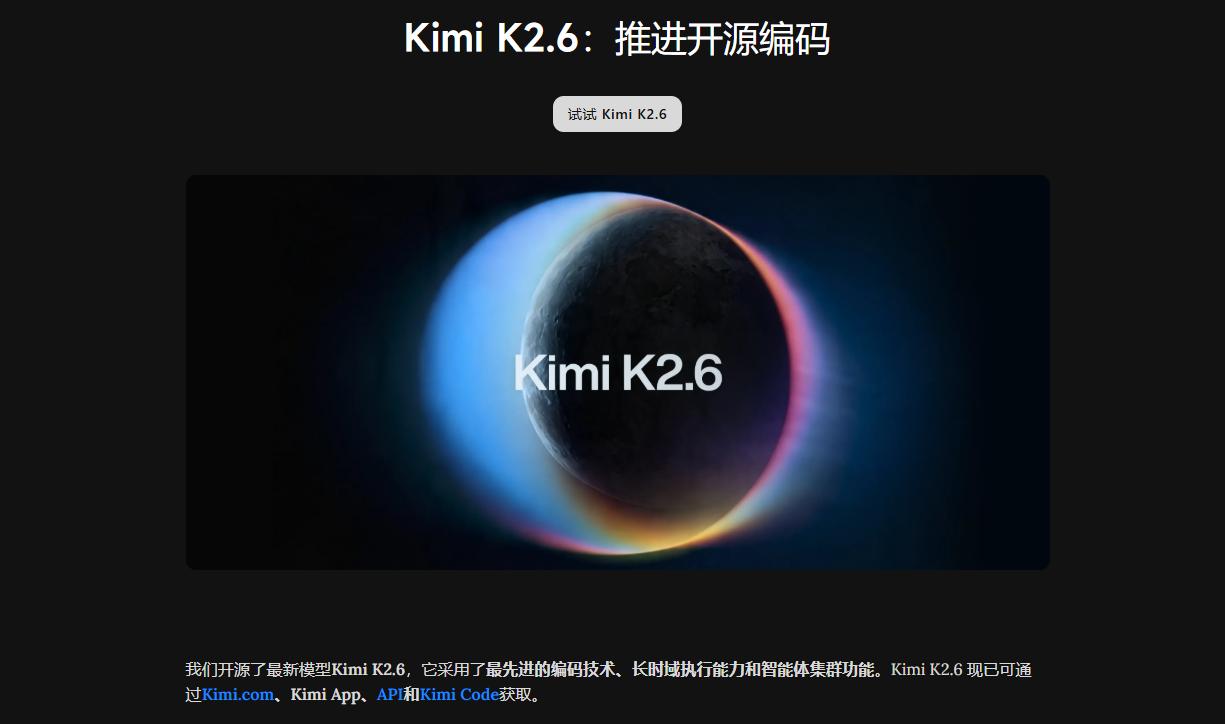
Kimi’s latest open-source model 2.6
More critically, K2.6 enhances agent capabilities. It supports breaking down complex tasks into multiple sub-tasks and scheduling multiple agents to work in parallel. Reports indicate it can schedule up to 300 sub-agents to complete around 4000 collaborative steps. This means Kimi is evolving from a “question-answering model” to a “system capable of executing continuous tasks.”
This is crucial for token consumption and commercialization.
In the past, a typical Q&A scenario might trigger only one model invocation; however, in agent scenarios, a single task may involve multiple steps including searching, reasoning, writing, code generation, organizing tables, generating web pages, and creating PPTs. Each additional step generates new token consumption.
Over the past two years, China’s large model industry has experienced a cycle of enthusiasm, cooling, and renewed interest. Kimi’s latest funding round, in some ways, also signifies that capital is re-evaluating AI in China.
Comments
Discussion is powered by Giscus (GitHub Discussions). Add
repo,repoID,category, andcategoryIDunder[params.comments.giscus]inhugo.tomlusing the values from the Giscus setup tool.